Public vs Private AI: What CIOs Get Wrong

Category: Enterprise AI Publish Order: 3/5
---
The conversation usually starts in the wrong place.
An executive team decides it needs an AI strategy. Then the next question becomes: should we use public AI or private AI?
That sounds reasonable. It is still the wrong framing.
The Wrong Axis
Most CIOs are pushed into a cloud-versus-on-prem conversation too early.
That framing reduces a governance problem into a hosting decision.
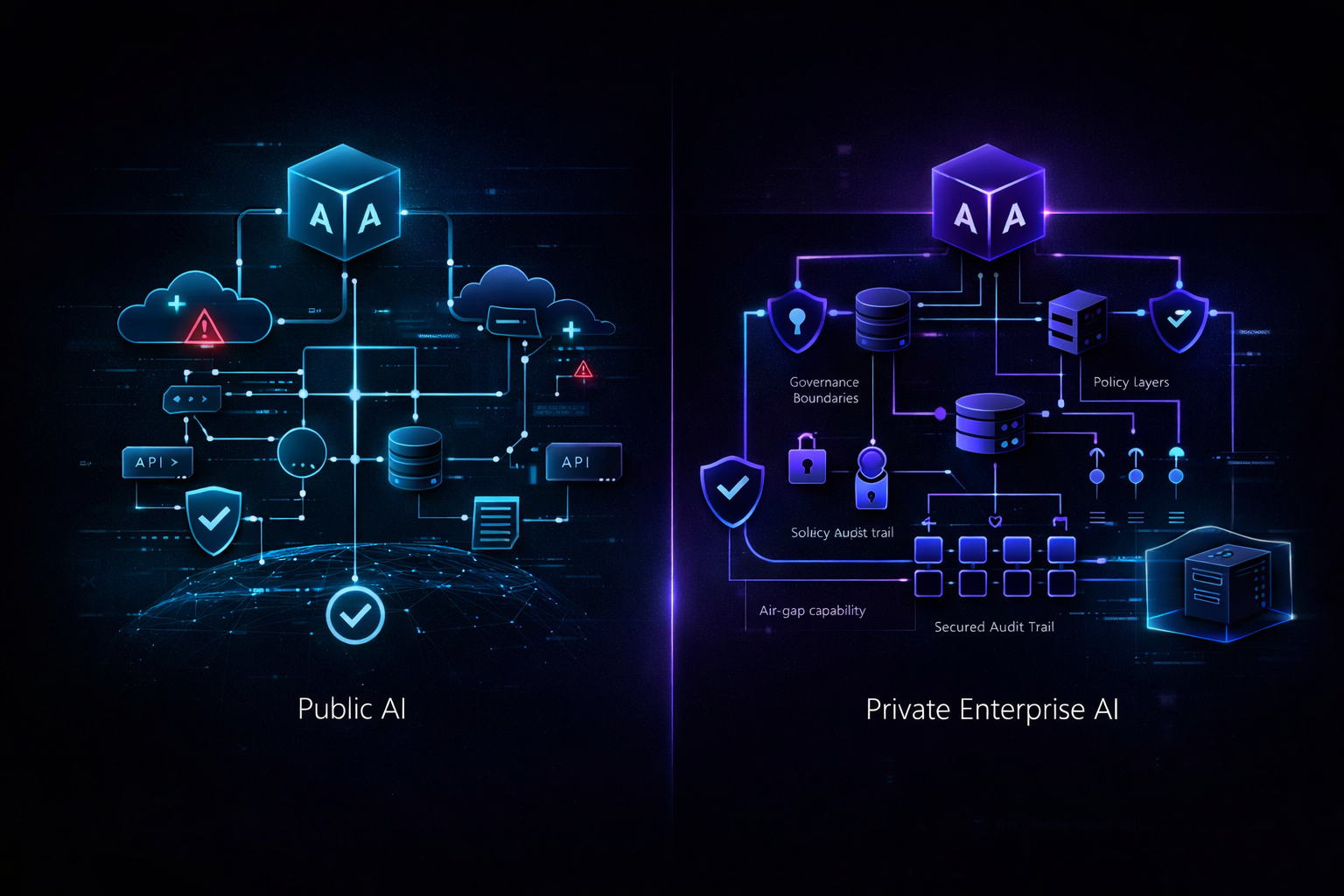
But enterprise AI is not defined by where it runs. It is defined by what it can prove, what it can enforce, and what it can safely execute.
What CIOs Should Actually Be Asking
Instead of asking whether the platform is public or private, ask:
- Audit: Can we prove what happened, when, and to whom?
- Access: Can we enforce policy-driven access at the data and execution layers?
- Execution: Can we control which tools and actions the AI is allowed to run?
- Deployment: Can we deploy it where our environment requires it, including private or air-gapped settings?
Those are enterprise questions. Hosting is only one part of the answer.
What Vendors Usually Mean by “Private AI”
When a vendor says "private AI," it often means one of the following:
- We run it in your cloud account
- Your prompts are not used for training
- Your data stays inside a private boundary
That is containment. It is not governance.
Containment is useful. It is just not enough.
What Enterprise-Grade Private AI Should Mean
Private enterprise AI should mean:
- append-only audit logs with cryptographic integrity
- policy-based RBAC that maps to real organizational boundaries
- allowlisted tool execution through a governed gateway
- private-cloud, on-prem, or air-gap deployment when required
- no hidden dependence on public infrastructure to remain operational
That is a very different standard from "we host it in your VPC."
The Real Taxonomy
| | "Private" AI | Enterprise AI | |---|---|---| | Hosting | Your cloud | Your cloud, private infra, or air-gap | | Data containment | Usually yes | Yes | | Audit | Session history | Provable, integrity-checked audit trail | | Access | Roles or workspace controls | Policy-based enforcement | | Tool execution | Often broad or opaque | Allowlisted and governed | | Deployment | Cloud-friendly | Deployable where internet may not exist |
Most so-called private AI platforms solve containment.
Enterprise AI platforms solve governance.
The Better Decision Framework
If a platform cannot answer the following clearly, it is not ready for enterprise adoption:
- How do we verify the audit trail?
- Where is policy enforced?
- How are tools restricted?
- Can this run without external dependencies?
If those answers are vague, the platform is not enterprise-ready even if it is technically "private."
Final Point
The public-versus-private question is too small.
The real question is whether the platform is governable, auditable, and deployable under enterprise constraints.
That is what CIOs need to evaluate. Everything else is marketing language.
---